
Walk into any high-volume packaging line and you'll see two adhesive technologies doing 90% of the work: hot-melt and pressure-sensitive. They overlap in obvious ways — both stick things together — but the application windows are completely different. Picking the wrong one means rework, line shutdowns, and warranty claims.
This is the side-by-side we wish more procurement teams had on day one.
The 60-Second Summary
| Hot-Melt | Pressure-Sensitive (PSA) | |
|---|---|---|
| Activation | Heat (melted, cooled) | Pressure (peel + stick) |
| Open time | Seconds to minutes | Indefinite |
| Bond strength | High, structural | Medium, removable variants exist |
| Line speed | Fast (sub-second set) | Limited by application mechanism |
| Substrate range | Wide — porous, non-porous | Wide — best on smooth, clean |
| Reposition / rework | No — bond is permanent on set | Yes (within tack window) |
| Equipment cost | Tank, hose, applicator | Often pre-applied (tape, label) |
| Best for | Carton sealing, palletizing, case erection | Labels, tape, removable closures |
Hot-Melt: When Speed and Strength Matter
Hot-melt adhesives are solid at room temperature, melted in a tank (typically 250-400°F), and applied via a heated dispense nozzle. They set in seconds as the bead cools — which is why they dominate carton sealing, case erection, and palletizing. A modern carton-sealing line runs at 60+ cases per minute; only hot-melt can keep up.
Sub-types worth knowing
- EVA (ethylene-vinyl acetate) — General purpose. Good adhesion to most paperboard. The default.
- Metallocene — Cleaner thermal profile, less char in the tank. Use on long production runs where tank life matters.
- PUR (polyurethane reactive) — Cures with ambient moisture, ends up nearly indestructible. Used for high-stress bonding (book binding, automotive interior, structural lamination).
- APAO (amorphous poly-alpha-olefin) — Slower set, longer open time. Bookbinding, profile wrapping.
Where hot-melt wins
- Closure speed on a moving line (the bead sets before the carton's next move)
- Bond strength on porous substrates (kraft, corrugated, paperboard)
- Cost per bond at volume — pellets are cheap, applicators amortize fast
- Tolerance to dust and minor surface contamination (vs PSA which needs a clean substrate)
Where hot-melt loses
- Heat-sensitive substrates (some films, foams, low-density polyethylene)
- Outdoor / temperature-cycled applications (the bond softens above 140°F)
- Anything you might want to peel off later
Pressure-Sensitive: When You Need a Clean Peel
Pressure-sensitive adhesives stick on contact, no heat, no water, no waiting. They're the adhesive class behind every tape, label, decal, and pouch closure you've ever used.
PSAs come in three flavors:
- Rubber-based — Cheapest. Good initial tack. Degrades with UV / heat. Standard packaging tape.
- Acrylic — UV stable, holds long-term, paler shelf appearance. Premium labels, outdoor signage, automotive.
- Silicone — Specialty. High-temperature applications, releases cleanly from low-energy surfaces (PTFE, silicone-coated liners).
Where PSA wins
- Labeling — Pre-applied to a release liner, peel and stick at the labeler. Zero adhesive activation step on your line.
- Tamper-evident closures — Some PSAs leave a "void" pattern when peeled, perfect for security seals.
- Re-positionable — Specific PSA formulations let you peel and re-apply (removable wall decals, repositionable shipping labels).
- Cold environments — Stays tacky down to 0°F or lower depending on chemistry. Hot-melt is brittle in a cold warehouse.
Where PSA loses
- Speed-critical lines (most PSAs need a few seconds under pressure to bond fully)
- Dusty / oily / wet substrates (the surface has to be clean)
- High-shear loads (PSAs creep under sustained weight)
- Cost on big bonds (covering a whole pallet wrap with PSA is not economical — that's where stretch film + tension wins)
How to Decide
Three questions, in order:
1. Does the substrate tolerate heat?
If your substrate softens or warps above ~200°F (some films, low-density foams, certain plastics) → PSA. Hot-melt would damage it before it bonds.
2. Does the bond need to be permanent or removable?
Permanent + structural → hot-melt (or epoxy / urethane for the most demanding cases). Removable, re-positionable, or tamper-evident → PSA.
3. What's the line speed?
Sub-second set required (case sealing at 60+ CPM, palletizing) → hot-melt. Slower or manual application, or pre-applied (labels) → PSA.
The "Both" Answer (More Common Than You'd Think)
Most real packaging lines use both. Hot-melt seals the carton, PSA labels go on the outside. Hot-melt closes the inner pouch, PSA tape closes the outer overbox. Don't treat it as one-or-the-other — treat it as "the right adhesive for each bond" and you'll spec better lines.
Where Ecko Fits
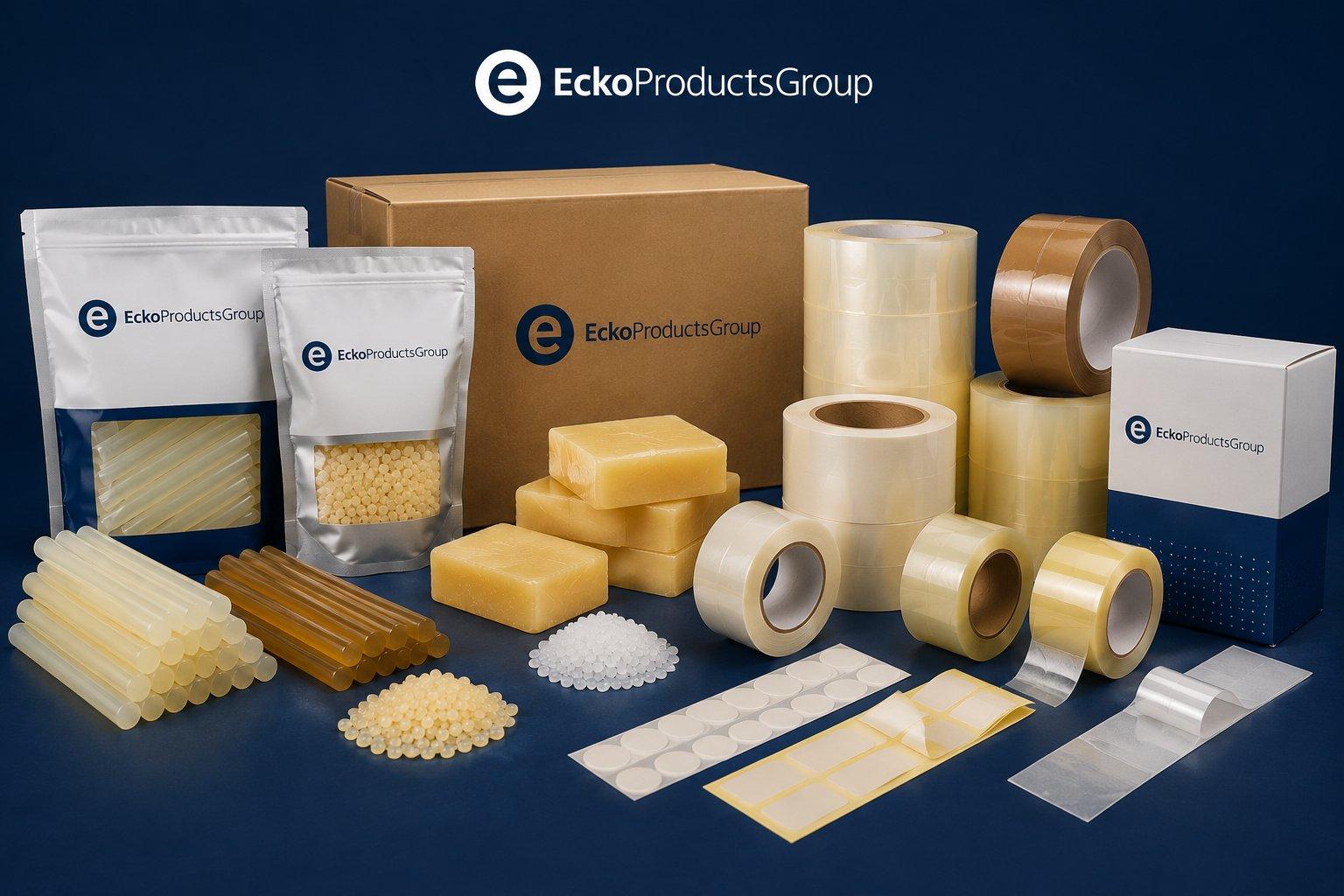
We stock industrial hot-melt cartridges, pellets, and PUR slats from premium suppliers, plus a full range of pressure-sensitive tapes (rubber, acrylic, paper, filament) and pre-printed labels. Our in-house specialists spec the right chemistry for your substrate, line speed, and end-use environment — and if the off-the-shelf options don't quite fit, we engineer custom formulations.
If you're not sure whether your line should be running hot-melt or PSA on a specific bond, send us the substrate spec and the line conditions. We'll come back with a recommendation and trial samples.
Need this for your business?
Get a custom quote from our team.
Tell us about your project — we’ll match it to the right packaging, materials, and run sizes for what you ship.